Enclosed Transport for Collector Cars: A Field Guide for the Garage You're Building
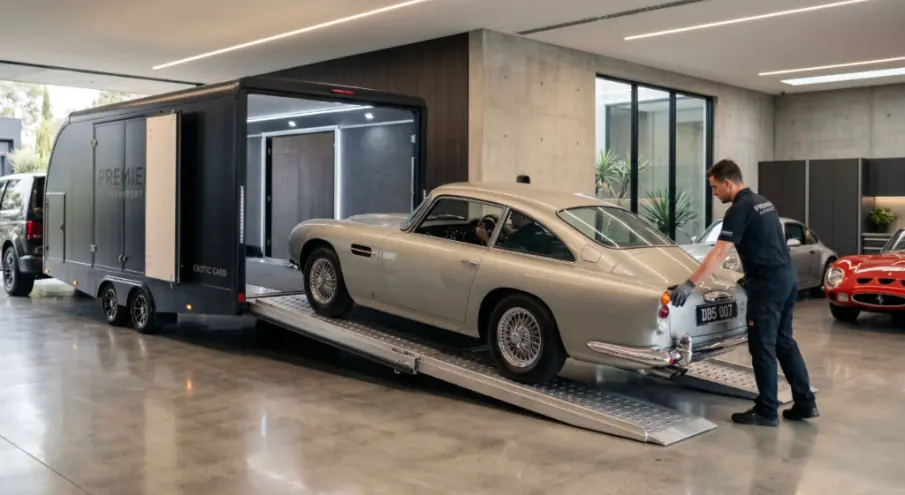
A friend of mine bought a 1969 Mustang Mach 1 at a Mecum auction last spring. Numbers-matching, 428 Cobra Jet, restored fifteen years ago and still showing well. He paid for it on a Tuesday and the seller's open carrier showed up to pick it up on Saturday. The car arrived three days later with a chip the size of a quarter on the front clip. The driver said a rock kicked up. The driver was probably right. The owner spent $1,400 fixing it. Open transport saved him $600 over enclosed.
That's the calculation collector car owners make once and never again. Open transport is fine for 95% of buyers. The other 5% are us.
This is a field guide for the second group. What to ask, what to look for, and which choices actually matter.
Why Open Is Fine for 95% of Buyers, and Why It Isn't for Yours?
Open carriers move 90% of vehicles in the United States, including most new cars from the factory to the dealer. The trailers are exposed to weather, road debris, and the occasional rock. For a daily driver headed to a new owner, that's an acceptable risk. The economics work.
For a collector car, the math runs the other way. A chip on a respray runs $400 to $800 in touch-up. A chip on original 1969 paint is unfixable. The savings on open transport disappear the first time it happens, and the resale impact follows the car for the rest of its life. If the car has provenance, original finishes, or any panel you wouldn't want to repaint, the enclosed car transport premium isn't optional. It's insurance you're paying upfront instead of after the fact.
The Three Enclosed Configurations
Not all enclosed trailers are the same. The three you'll encounter:
Single-tier (single-deck). One row of cars, fully enclosed, soft tie or wheel net only. Used for the highest-value shipments. Pricing is the highest of the three because the trailer carries fewer cars per run.
Two-car (multi-car enclosed). Two to six cars depending on trailer size, enclosed walls and roof. The standard mid-tier option. Cars are still protected from weather and debris but share trailer space.
Lift gate. A hydraulic platform at the rear of the trailer that lowers to the ground. Used for cars too low to be driven up a ramp without scraping. This matters for split-window Corvettes, certain Porsches, modified low-stance cars, and anything with under three inches of ground clearance.
If your car is low enough that ramp loading is a real concern, the lift gate is non-negotiable. Ask before you book whether the assigned trailer has one. About 30% of enclosed trailers don't.
Loading the Low Car: Lift Gate vs. Ramp Angles
A standard ramp on an enclosed trailer has a break-over angle of about 11 degrees. A 1970 Boss 302 with stock ride height clears that. A lowered show car frequently doesn't. The way you know is to measure the lowest point of the car (usually the air dam or the exhaust mid-pipe), then ask the dispatcher for the ramp's break-over angle and the load height at the front of the trailer. If those numbers cut it close, you want the lift gate.
The other detail to ask about: where the tie-down points will be. Loading a low car onto the trailer is only half the problem. The straps have to attach somewhere the driver can reach without crawling under a car that's still on a sloped surface.
Tie-Down Mechanics: Soft Straps, Wheel Nets, Axle Chains
Three ways to secure a collector car:
Soft straps over the wheels. The gold standard for valuable cars. Straps wrap the tire and ratchet down to anchor points in the trailer. Nothing touches the car body, suspension, or axle.
Wheel nets. Similar idea, basket-style net over the wheel. Slightly easier and faster to install than soft straps. Acceptable for almost any car.
Axle chains or frame straps. Faster, cheaper, used on standard open transport. Compresses suspension in transit. Acceptable for daily drivers. Not acceptable for a collector car, especially one with original springs or shocks you don't want to load-test for 2,400 miles.
Specify soft straps or wheel nets when you book. Some dispatchers will ask. Most won't. Tell them anyway.
Climate Control: Which Carriers Actually Have It
The phrase climate-controlled enclosed transport gets used loosely. There are three things it might mean:
- The trailer is insulated. Common.
- The trailer has active ventilation. Less common.
- The trailer has actual heat or air conditioning. Rare and expensive.
For a four-day cross-country run through any month except July or January, an insulated trailer is enough. The temperature inside an enclosed trailer running through Texas in summer can hit 130 degrees by mid-afternoon. If your car has materials sensitive to that (period vinyl, original interior leather, certain paint formulations), it's worth paying for active ventilation or scheduling the move outside the worst months. True climate-controlled trailers exist but you should expect to pay an additional 20% to 40% premium.
The Auction Pickup Playbook
If the car is coming out of an auction (Mecum, Barrett-Jackson, Bring a Trailer, Gooding), there's a process. Most major auctions have a designated transport coordinator on site. The buyer pays the auction, then the buyer (not the auction) arranges transport. Before you bid, confirm the carrier's authority is active by checking FMCSA SAFER so you don't end up with a fly-by-night transporter holding a six-figure car.
Three things to do before the auction:
- Have an enclosed carrier preliminarily booked, with the trailer profile (single-tier or two-car), tie-down method, and lift gate availability already confirmed.
- Bring the title work, paid receipt, and pickup authorization in writing.
- Confirm the pickup window with the auction storage facility. Mecum holds cars for 72 hours after sale; Barrett-Jackson is shorter. Storage fees accumulate after that.
Bring a Trailer is the outlier. The platform doesn't store cars, so the buyer and seller arrange pickup directly, often from a private garage or shop. That changes the carrier conversation. Schedule with the seller before you book the transport, then give the dispatcher both addresses and a 48-hour pickup window so the driver has flexibility.
For a vehicle of significant value, ABC Auto Shipping and similar enclosed transport providers can coordinate pickup directly with the auction yard, which is faster than trying to do the handoff yourself.
What the Carrier Driver Wishes You'd Tell Them at Pickup?
Drivers transport thousands of cars a year. Their default is to handle yours like a daily driver. The information they wish you'd volunteer at pickup, in order:
- Anything that's been recently restored or repainted (so they avoid wiping down that panel with a dirty mitt)
- The exact starting procedure if it's not turn-key (carbureted cars, period-correct fuel mixtures, manual chokes)
- Where the kill switch is, if there is one
- Any known oil leak, even if minor (they will put a drip pan under it)
- Anything weird about the suspension or steering at low speed (so they don't think it's broken when they load)
A two-minute walk-around with the driver before they load is worth more than any insurance line on the bill of lading. The driver who knows the car was just restored handles it differently. They are professionals. Give them the information that lets them act like it.
The collector car community got bigger and the carrier capacity didn't grow with it. Book enclosed transport 4 to 6 weeks ahead for a major auction or show, walk the car with the driver at pickup and again at delivery, and write down the trailer configuration when you book so you can confirm it on arrival. That's the playbook. The hard part of owning the car is buying it. The transport part is solved.
More to Read:




Previous Posts: